Last updated: November 16, 2026
Saline vs silicone breast implants differ mainly in their filling, feel, tendency to show rippling, insertion and rupture detection. Neither is the best choice for every body: your existing breast tissue, skin and desired size matter as much as the fill. At Skinsational Cosmetic Surgery Clinic in Providence, Rhode Island, we plan breast augmentation around those factors.
What is the difference between saline and silicone breast implants?
Both types have a silicone outer shell, but saline breast implants contain sterile saltwater and silicone breast implants contain silicone gel. Saline implants are usually inserted empty and filled in place; silicone implants arrive filled. Silicone generally feels softer, while saline deflation is usually easier to notice after a rupture. The U.S. Food and Drug Administration also notes that some saline implants arrive prefilled.
What are the different types of breast implants?
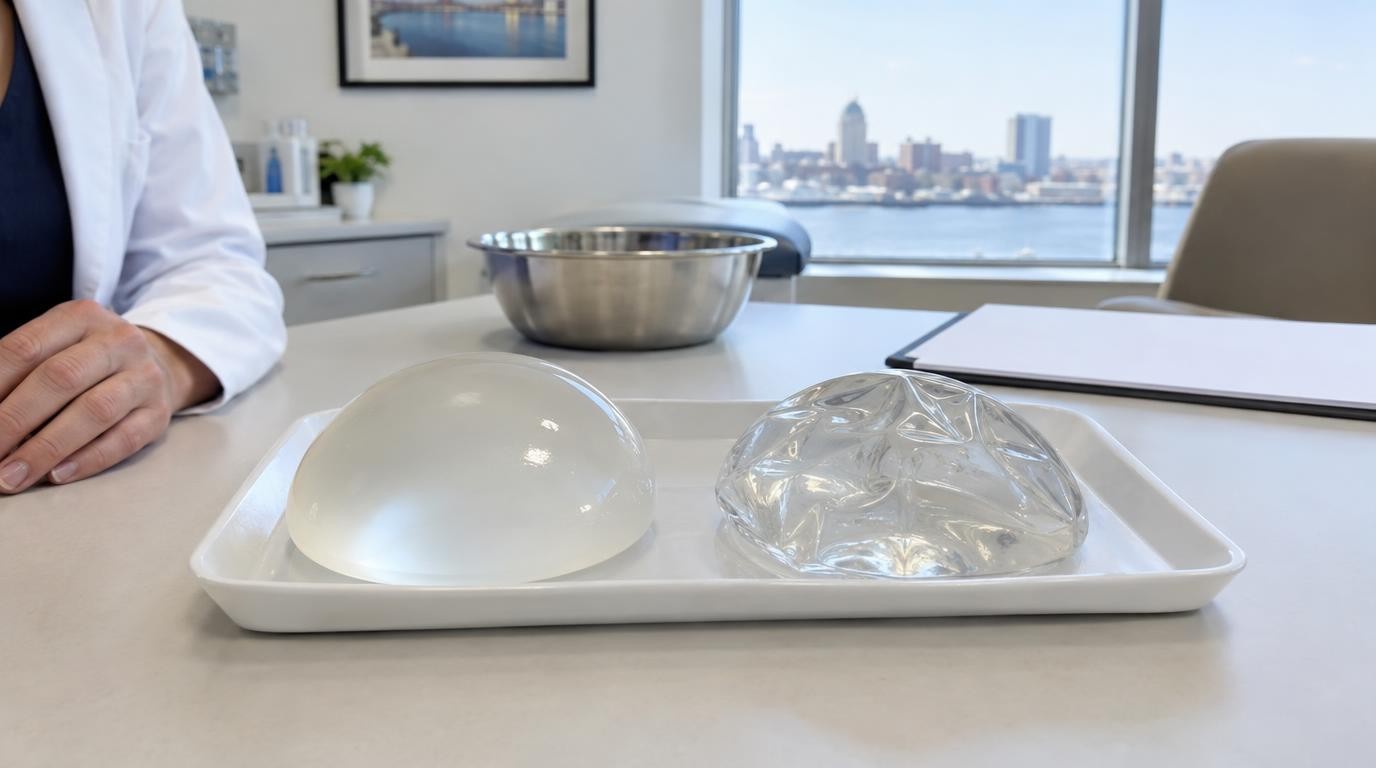
The two main implant types by fill are saline and silicone gel. The Cleveland Clinic’s breast augmentation overview also describes structured saline implants, which have an internal structure intended to improve how they feel, and form-stable (“gummy bear”) silicone implants, whose thicker gel holds its shape more firmly. Shape and shell surface are separate choices, and silicone gels vary in cohesiveness. Fill alone does not determine which implant dimensions or placement suit your anatomy.
The main fill-related differences, including the relative weight noted in an American Society of Plastic Surgeons comparison, are:
| Feature | Saline | Silicone |
|---|---|---|
| Filling and insertion | Sterile saltwater; usually filled after insertion | Silicone gel; inserted filled |
| Relative weight | Generally heavier than a comparable silicone implant | Generally lighter than a comparable saline implant |
| Feel and rippling | May feel firmer; folds can be more noticeable beneath thin tissue | Generally feels more like breast tissue; rippling remains possible |
| Rupture detection | Deflation usually changes breast size or shape visibly | Rupture may cause no noticeable change |
The table describes tendencies, not a guaranteed appearance or feel for an individual patient. Weight alone does not determine the best choice for you.
How does a rupture become noticeable with each type?
The Mayo Clinic’s comparison of saline and silicone implants notes that a ruptured saline implant typically flattens as the body absorbs the leaking saltwater. The leaking saline itself is not a health risk. A silicone implant can rupture without an obvious change because its gel may remain within the shell or surrounding scar tissue. A change in shape, firmness or swelling still deserves assessment regardless of implant fill.
What are the most natural-looking breast implants?
Silicone implants often look and feel more like natural breast tissue, especially when little existing tissue covers the implant. Saline implants can also produce natural-looking results when there is enough coverage and the size fits the breast. Fill alone cannot determine the result; skin, implant dimensions and pocket placement also shape what you see and feel.
Why does breast tissue coverage affect visible rippling?
Thin tissue provides less padding over folds in an implant shell. An American Society of Plastic Surgeons blog post notes that saline implant folds may be seen or felt more often beneath very thin skin. Silicone may reduce that concern for some patients, but either material can ripple. In clinical practice, the question is not simply which sample feels softer on a table; it is how that implant will feel beneath your own tissue.
Can either implant type address lost volume or uneven breasts?
Either fill can add fullness, restore lost breast volume or help balance uneven breasts. Size selection and placement are important when the breasts differ, and perfect symmetry is not a realistic promise. Significant sagging is a separate concern: an implant adds volume but may not provide the repositioning a breast lift can achieve. Our guide to breast augmentation with a lift explains when those goals may call for a combined plan.
Implants are not the only way to add volume: fat-transfer augmentation uses your own fat instead of an implant. At Skinsational, we plan augmentation with saline or silicone implants; if fat transfer interests you, ask our team whether it is available.
How does your anatomy determine whether saline or silicone suits you?
If you have limited tissue covering an implant, silicone may reduce visible or palpable rippling; with ample coverage, either fill may suit you. We also consider your skin, asymmetry, preferred size and goals. Neither fill guarantees a particular result.
When might a smaller incision or fill adjustment matter?
Because a saline implant is usually filled after placement, it may pass through a smaller opening than a filled implant of comparable size. Its volume can also be adjusted during surgery, which may help when addressing modest differences between breasts. The incision still has to allow safe access and accurate placement; fill material does not guarantee a particular incision.
How do existing tissue, skin and desired size affect the plan?
Breast width and tissue coverage influence which dimensions can be accommodated, while the skin envelope affects how added volume will sit. Choosing more volume than the tissue comfortably supports may make implant edges or rippling more apparent. For another educational look at how surgical choices work together, see this overview of modern breast augmentation techniques.
How are saline and silicone implants placed at Skinsational?
During breast augmentation, Dr. Luciano Sztulman makes an incision, creates a pocket beneath the breast tissue or chest muscle, and places the implant in it. At Skinsational Cosmetic Surgery Clinic, we plan the implant material, size, pocket position, incision and recovery guidance around your anatomy and goals. We offer FDA-approved Mentor implant options.
Where can the implant pocket and incision be placed?
Placing the pocket beneath breast tissue or beneath the chest muscle changes the amount of tissue over the implant. At Skinsational, a transaxillary incision in the underarm is a common approach; its scar is outside the breast rather than on the breast itself. Saline implants are usually inserted empty and filled in the pocket, while silicone implants are placed already filled. Pocket and incision choices also depend on the implant selected and the access needed to place it appropriately.
Does implant fill determine the incision Dr. Luciano will use?
No. Empty insertion may give saline an incision-size advantage in some plans, but Dr. Luciano considers implant size, placement and individual anatomy before recommending an approach. Silicone fill does not, by itself, rule out an underarm incision. Patients who want more detail about incision healing can read our guide to breast augmentation scars and care.
What are the potential risks associated with breast implants?
Breast augmentation carries surgical risks, including bleeding, infection and anesthesia-related complications, as well as implant risks such as capsular contracture, rippling, asymmetry, implant displacement or malposition and rupture. Breast or nipple sensation can change, and breast pain may persist beyond expected short-term postoperative discomfort. Augmentation may also affect breastfeeding; if you hope to nurse in the future, discuss this with Dr. Luciano during planning. An American Board of Cosmetic Surgery article on augmentation complications estimates that capsular contracture occurs in about 10% of patients. Further surgery may become necessary. The American Society of Plastic Surgeons’ breast augmentation safety page also outlines possible surgical and implant complications.
Who may need to postpone or avoid breast augmentation?
An active infection, an unresolved breast concern, a health condition that increases surgical risk or expectations surgery cannot meet may call for postponing or reconsidering augmentation. If you are pregnant, postpone elective cosmetic augmentation. If you are currently breastfeeding, discuss when surgery can safely be considered. Eligibility is individual rather than a checklist that makes everyone with the same condition an unsuitable candidate. The FDA approves saline implants for cosmetic augmentation in adults age 18 and older and silicone gel implants for cosmetic augmentation in adults age 22 and older.
Rare cancers associated with breast implant capsules also warrant an informed discussion. Breast implant-associated anaplastic large cell lymphoma (BIA-ALCL) is extremely rare and associated primarily with past styles of highly textured implants. Breast implant-associated squamous cell carcinoma (BIA-SCC) has also been reported in implant capsules. These risks should not be taken to mean that every implant surface or patient has the same risk. The American Society of Plastic Surgeons’ breast implant safety information also discusses reported symptoms such as fatigue, difficulty concentrating and joint pain, sometimes called breast implant illness; whether implants cause these symptoms has not been proved.
What follow-up is needed if an implant ruptures?
A visibly deflated saline implant needs evaluation, and its silicone shell must be removed surgically; a replacement implant can often be placed during the same operation. A suspected silicone rupture also needs assessment, even when no change is visible. If a rupture is confirmed, you and your surgeon may need to discuss surgical removal and possible replacement.
An article on the American Society of Plastic Surgeons’ website cites a surgeon’s recommendation to monitor silicone implants for rupture beginning at five years after surgery and then every two to three years. Checking for a rupture that causes no visible change may require an ultrasound or MRI specifically directed at the implant. A routine breast-screening ultrasound may examine breast tissue without checking the implant, so do not rely on breast cancer screening alone to assess implant integrity.
After surgery, seek urgent medical care for trouble breathing, rapidly increasing swelling or severe pain. Report fever, spreading redness, drainage, a new breast mass or a persistent change in shape promptly. Discuss your health history, implant risks and follow-up plan with your own clinician before deciding on surgery.
Can saline breast implants last a lifetime?
No saline or silicone breast implant has a guaranteed lifetime lifespan, and you should not plan on a saline implant lasting 50 years. An American Society of Plastic Surgeons article on implant replacement says implants typically need replacing after about 10–15 years, although some last longer. An intact implant does not automatically need replacement on a fixed anniversary, but rupture, capsular contracture, symptoms or changing goals can prompt evaluation and possible surgery.
Do silicone implants also need monitoring or eventual replacement?
Yes. Both fills can require removal or replacement, although timing varies by patient and implant condition. An American Society of Plastic Surgeons blog post on implant exchange explains that the former rule of thumb of replacing implants after about 10 years is not a hard rule. For a closer look at the reasons an older implant may need attention, read our guide to when to replace aging breast implants.
How long does breast augmentation recovery take?
At Skinsational, most discomfort improves after 2–3 days, patients generally resume daily tasks in weeks 1–2, and exercise returns gradually from week 4 onward unless Dr. Luciano advises otherwise. Recovery varies from person to person with either implant fill. Follow-up visits let our team assess healing and adjust activity guidance to your progress.

When can patients resume daily activities and exercise?
Skinsational uses the following general recovery sequence, subject to Dr. Luciano’s instructions:
- First 24–48 hours: Rest, limit movement and wear a support bra at all times.
- First week: Keep activity light; most discomfort improves after 2–3 days.
- Weeks 1–2: Resume daily tasks while avoiding strenuous activity.
- Weeks 4+: Return gradually to exercise and full activity unless Dr. Luciano advises otherwise.
Your procedure and healing at follow-up—not the calendar alone—determine when you can safely increase activity.
Frequently Asked Questions
Do the FDA’s augmentation age limits also apply to breast reconstruction?
No. Those age limits apply to cosmetic augmentation; saline and silicone gel implants are approved for breast reconstruction at any age.
Can a form-stable silicone implant affect incision planning?
Yes. Form-stable implants require a longer skin incision, which can limit incision choices. Dr. Luciano will discuss whether the implant and planned access route work together for your anatomy.
Should I choose round or shaped breast implants?
Neither shape is automatically better. Round implants typically create more fullness in the upper breast, while shaped implants can create a more gently sloping profile. Round implants also generally do not change the breast’s appearance if they rotate. At Skinsational Cosmetic Surgery Clinic, we consider your anatomy and preferred look alongside implant shape.
What is the difference between smooth and textured implant shells?
Smooth shells generally feel softer and move more freely, while textured shells grip surrounding tissue and are less likely to rotate. Both saline and silicone implants can have either shell surface. Shell surface is a separate choice from fill; we discuss its safety considerations in the risks section above.
What anesthesia is used for breast augmentation at Skinsational Cosmetic Surgery Clinic?
Most of our breast augmentation patients receive local anesthesia with sedation, sometimes called awake breast augmentation. Some patients need deeper sedation based on their individual circumstances. We review the planned anesthesia with you before surgery; the choice depends on your health, comfort needs and the details of your procedure.
Can I still get mammograms after saline or silicone breast implants?
Yes. You can still have mammograms with either implant fill. Tell the imaging center about your implants when scheduling so the technologist can use appropriate views to examine breast tissue. A mammogram for breast cancer screening is not a substitute for follow-up specifically intended to check a silicone implant for rupture.
How can Johnston patients decide which implant to discuss at a consultation?
Patients coming from Johnston, Rhode Island, do not need to choose a universal winner between saline and silicone before a consultation. A useful decision starts with tissue coverage, skin, desired size, asymmetry and willingness to follow different rupture-monitoring plans. Dr. Luciano can relate those factors to the implant and surgical options available at Skinsational Cosmetic Surgery Clinic in Providence.
What questions should you bring to Dr. Luciano?
- How much of the implant would my existing tissue cover, and where might rippling or an edge be noticeable?
- What implant dimensions fit my breast width, skin envelope and desired fullness?
- How would either fill help with asymmetry, and would sagging require a separate discussion?
- Which pocket and incision make sense for my anatomy and implant choice?
- How would I recognize a problem, and what monitoring would my implant require?
If you are considering cosmetic breast augmentation, contact Skinsational Cosmetic Surgery Clinic to arrange a personalized consultation with Dr. Luciano Sztulman in Providence, Rhode Island. We can help you compare the options against your anatomy rather than a sample implant alone.
This information is general and is not medical advice. Talk to a licensed clinician about your own situation before making a treatment decision.